
Residents plant more than 200 milkweed plants in 2022 to attract declining species
With the numbers of monarch butterflies that migrate annually across North America decreasing considerably over the last decade, Rappahannock Westminster-Canterbury (RWC) residents have embraced these beautiful and graceful creatures as a community-wide project.
Starting in 2021, residents started this citizen science project by planting milkweed plants – the monarch caterpillars’ critical food – to attract the declining species and documenting every life stage of the monarch (egg, larvae, chrysalis or adult).
Ringleaders of the project – residents Nick Ferriter and Jane Henley – in 2021 purchased 200 Swamp Milkweed and planted them next to the RWC community garden in the newly christened “Butterfly Sanctuary.” They also sold more than 100 of the plants for $2 each, so RWC residents could plant them in their own backyards to support monarchs and attract butterflies.
They repeated the process in 2022, but sold even more plants in the community.
“Other residents this year became very enthusiastic and planted milkweed to attract the butterflies,” Ferriter said. “A dozen residents are actively growing milkweed this year, and we hope to triple that next year. Many of us have been fairly successful in getting the milkweed to grow.”
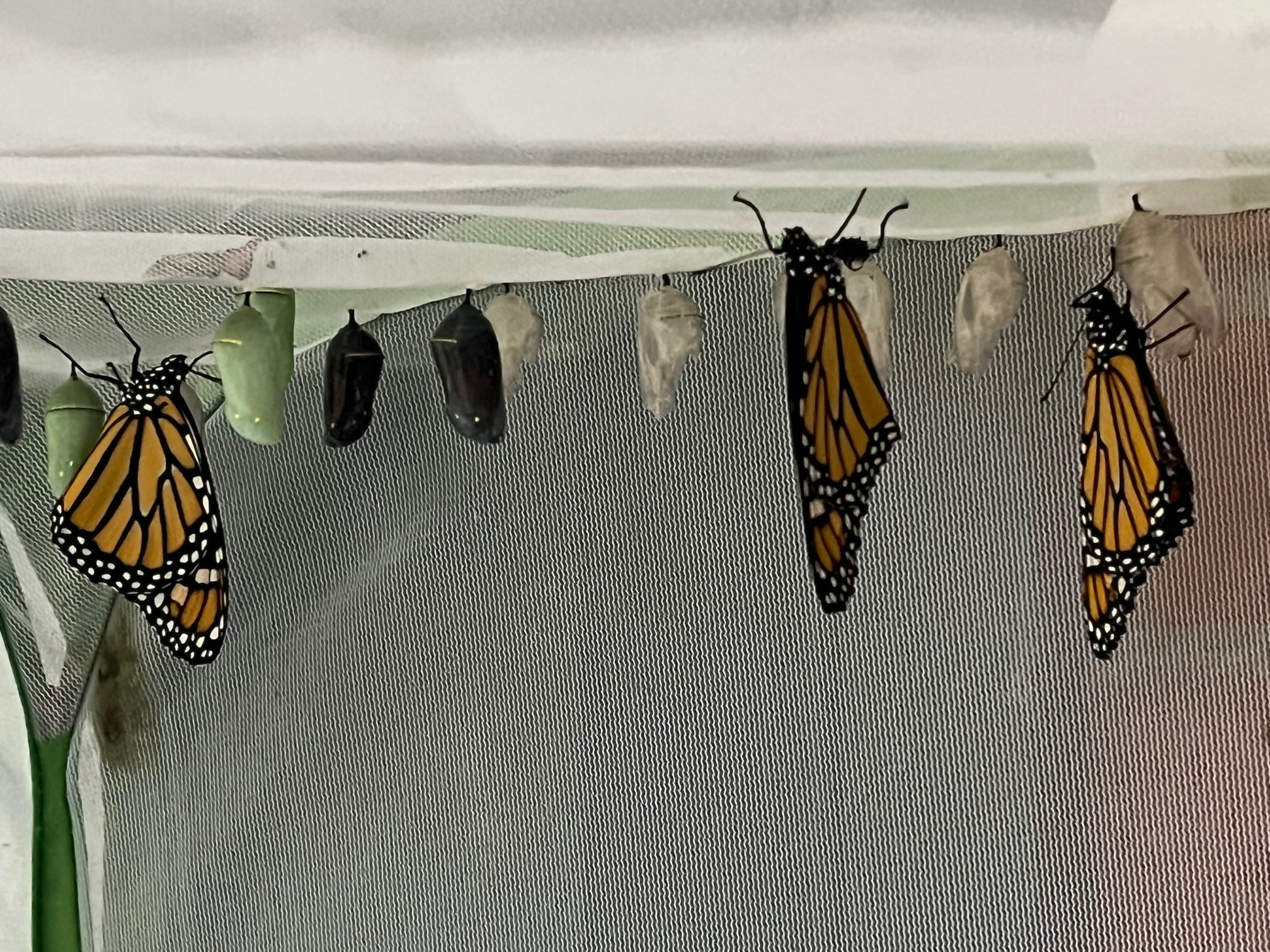 The butterfly’s life cycle works like this: The female caterpillar lays eggs on the milkweed. They hatch into baby caterpillars or larvae. The caterpillars eat milkweed for about two weeks, then they find a place to attach themselves to a stem or leaf to transform into a chrysalis.
One challenge for interested residents is that if they don’t know where the chrysalis is attached to the milkweed or what it looks like, then they won’t know how it’s progressing. RWC solved for this by placing a box in the Atrium of the Life Enrichment Center allowing residents to watch and learn the evolution of captive caterpillars as they feed on milkweed and form their chrysalis.
Additionally, some residents ordered mesh monarch butterfly cage terrariums, which allow for dramatic releases when the chrysalises evolve into butterflies.
While it’s been an exciting year for RWC’s monarch butterfly enthusiasts, the insects will soon begin their “great migration.” Monarchs are not able to survive cold winters, so the beautiful orange and black butterflies make the trip from Mexico and back to points east of the Rocky Mountains twice a year looking for milkweed plants on which to lay their eggs.
The two-way migration can often stretch up to 3,000 miles and is a difficult journey. Accordingly, the massive migration seems to be declining and the iconic insects are disappearing.
In July 2022, the International Union for the Conservation of Nature named the migratory monarch butterfly to its Endangered “Red List.”
For now, RWC residents are doing their part to help reverse the trend. Ferriter and Henley and other volunteers will be once again next season monitoring the Butterfly Sanctuary frequently checking for eggs and caterpillars as well as selling milkweed to fellow residents and encouraging additional habitats throughout the RWC community.
For more information on monarch butterflies, go to https://journeynorth.org/monarchs
To see a monarch butterfly’s metamorphosis, watch a video on RWC’s YouTube channel.