
 By Peter & Jenny Saam
If the accent doesn’t give it away, the license plates – GDAYM8-1 and GDAYMA8-2 – will. Yes, we still have a lot of Aussie in us, even though we have been U.S. citizens since the mid-90’s. We came to America on a two-year assignment in 1978, but as an immigration story, there are a lot more turns in this tale.
I (Peter) was actually born in Germany during WWII. I emigrated with my family to Australia as a 13-year-old. My early childhood was marred by the war and its aftermath when playgrounds were mostly bombed-out buildings. I remember the “Ami,” as the good guys. The first orange I had ever seen or smelled was tossed to me by a GI from a Jeep on a street corner.
Who would have thought – the Northern Neck, 70-plus years later? What drove the kitchen-table discussion at that time? … the notion of a better life, the cloud of the Soviet threat and a spirit of adventure. Well, that last one really resounded with the youngster. Australia … where is that? …. on the other side of the world …. who’d ever heard of kanga-oos? I’d never seen an ocean or a desert.
Mother packed our finest china. Six crates held our treasures. The vessel, Anna Salen, was a rebuilt cargo ship with multiple open spaces in her holds, cramped with triple decker bunks and segregated by gender. We traveled out into the North Sea, around Gibraltar, through the Suez Canal and ever onward, south-southeast. I vividly remember seeing flying fish while crossing the Indian Ocean.
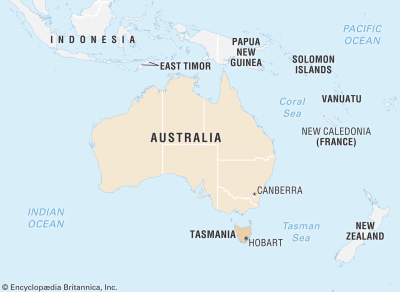 After some five weeks, they disembarked in Melbourne. The family settled in Sydney. I took to the beaches and the easy-going Aussie way like a duck to water. Three years of English back in Germany, made for a smooth transition. I eventually learned another language – programming computers. This was at a time when most computers took up a whole office building floor, and it took me to Tasmania (one of the six Australian states), where I met Jenny.
Jenny grew up on the land. Her father, a boyhood immigrant from England, after WWI, had become self-sufficient with the fruits of his labor, gradually building up a small apple orchard.
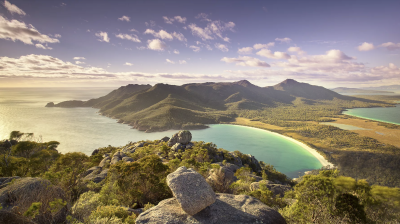
Life was frugal, but happy. Her fondest memories are summer holidays at St. Helens, on the East Coast. Even today, Tasmania is still unique; it is an island state with a relationship to the “mainland” somewhat akin to Hawaii and CONUS (Continental U.S.). It is beautifully rural with almost a quarter designated a wilderness area. It also shows its English heritage more than the other Australian states.
We met when a common friend got engaged. Still at Teacher’s College, this was bound to take some time. In fact, by the time they got engaged, I had already taken up a new job, all the way in Queensland while Jenny was teaching primary school in Mole Creek (almost as remote as it sounds), Tasmania. She loved the chil-ren’s bond with nature – the simple life, and even had some part-time work in the leather-wood honey production, unique to the area. We got married in 1969.
By 1973, we had relocated to Sydney, when Jenny spotted an advertisement from an American company. Kepner Tregoe, was seeking to add staff in Southeast Asia. Here is the final link of this journey. Jenny was teaching primary students in a Sydney suburb, while I attended clients throughout Australia and Southeast Asia. In 1974 we had a son and a second in 1975. The call from America in 1978 – while I was at a papermill in the Philippines came out of the blue: “We would like you to go to the States for a two year assignment.”
The move to Princeton, NJ was as smooth as silk. We had legal resources easily available, “home-leave” once a year, spoke the same language (almost – we still say rubbish rather than trash), and even brought a considerable amount of furniture. Determined to experience as much as possible on the way back from Down-Under, we would stop off on the West Coast to visit as many national parks as possible. We wanted to take it all in.
In 1987, I went into partnership in a small, private consulting business, an early adopter of “work from home.” One year led to the next. In time, our sons, 3- and 4-years-old when we arrived, were now immersed in their college education.
Grandchildren (five now) would inevitably be American and we ourselves became U.S. citizens. Finally, looking around all the housing developments that had supplanted the corn fields around Princeton, we decided a move was in order.
We’ve lived in the Northern Neck for almost 24 years, retiring shortly after coming here. We love the serenity, the people and the natural beauty. So, there you have it.
A kaleidoscope of cultures, habits, customs and traditions from three continents. We follow Duke basketball and Michigan football, cheer Bayern Muenchen in the European Champions League, unapologetically root for any Aussie in the tennis majors and gleefully watch the USA medal count in the Olympics. And we have settled in well at RWC. Thanks a million, to the staff that care for us, and to the new friends we are making here.