
 By Milena Van Sant
During WWII my parents and I lived in Berlin, Germany and Vienna, Austria. After the war, we had the bad luck of moving to Prague, now the Czech Republic. about a year or so before the Soviet communist regime took root.
In 1950 we were able to extricate ourselves and landed in a small town in Germany, not too far from Cologne. With my mother’s death 8 years later, my role as a caretaker came to an end and, pushing 21, I was forced to begin formulating some sort of a future for myself.
I began perusing the want ads in one of the two largest German newspapers and on a particularly auspicious day came upon a perfect opportunity.
An enterprise in Paris, France, was seeking to hire a multilingual person to work with academics and clerics traveling abroad. Bingo! Fluent in German, Russian, English and Czech, with a passable knowledge of French (which would be enhanced by spending time in Paris) I was without any doubt a perfect candidate.
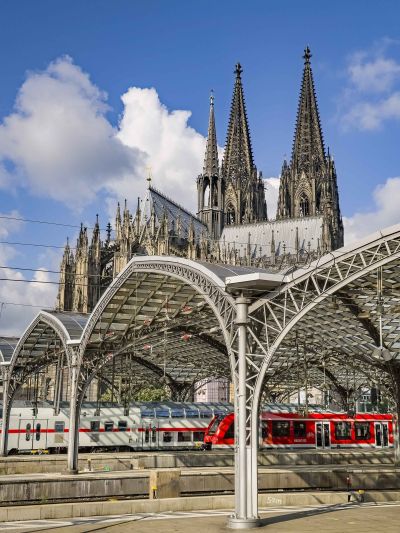
The main train station in Cologne offered frequent train options to Paris, and it would take about 2-1/2 hours to reach the destination. And the same in reverse, when I would be able to visit my father on countless occasions. City of Love, here I come!
As expected, my application was well-received. Father and I met the owner of the special travel agency in a restaurant in Cologne. He appeared to be somber and even gloomy and was accompanied by a young and perky woman whom I would be replacing. We spoke in English and I translated for my father. At the end of a lengthy interview, I was told that the job was mine.
But there was a catch. A rather significant catch.
I would have to move far, very far from my home and the City of Love. I would need to move to Trenton, New Jersey, where the agency was headquartered.
Although I could point out the State of New Jersey on a map, Trenton was something of an enigma. My throat was suddenly dry, but I was too afraid to lift a glass of lubricating water with my sweaty palms. After a private and intensive conference with my selfless father, we agreed that I would relocate, with a vast ocean to separate us.
A whole new world opened up before me in the fall of 1959.
During the flight to our destination my new boss introduced me to Mad Magazine (with an absolutely incomprehensible content for me) and generously bought me a glass of root beer (with the taste of a mouthwash, in my opinion).
For the first morning in the Trenton home-cum office I was served breakfast by the only other working employee of the agency, the meek and near-cowering wife of my employer. The meal consisted in part of Tang, reconstituted powdered milk, and Wonder bread.
Instead of the City of Love with its world famous food, had I arrived to some farcical offering in a comedy of a fake Land of Milk and Honey?
After some months I came to the inescapable realization that my new job might not, in the long run, be sustainable. I was gradually losing personal space, self-respect and identity to my boss. But returning to Germany would, in my mind, signal defeat to my endeavor of creating a life for myself.
What recourse was available to me? I felt utterly alone in a vast, foreign land.
It was at this point when I was introduced to the American spirit of offering assistance to the helpless and needy. Neighbors who had observed a rapid turnover of young women working at the agency stopped me in the street one day to ask how I was doing. This, I learned, was the American mantra of “how can we help?”
True to their concern, they helped me to relocate but, importantly, they helped me to grasp the caring and benevolence of everyday American people who were used to interdependence. They helped me to understand that I was not alone.
Armed with my original work permit, I found a job in the City of Brotherly Love, with a Philadelphia export company. I periodically reported to the immigration authorities and duly paid my yearly taxes. Slowly but surely, I began falling in love with my new country, the multicolored crazy quilt of other immigrants with our many different customs and ways of life all somehow melding into one.
As time went on, I married an American and welcomed four children, brand new birth citizens of the United States. The time had come for me to apply for my own citizenship. The year was 1973 and we were living in Charlotte, North Carolina.
 Becoming naturalized was then, and still remains, an arduous and expensive process, involving a thorough study of American history and civics, culminating in a naturalization interview and test.
At the same time I had to demonstrate a good moral character and did my level best to look virtuous throughout. I found it most difficult to swear under oath that I would bear arms when duty called. (This item has since been amended to include noncombatant service.)
Having seen some of the horrible effects of war as a child, it was difficult to imagine myself aiming a loaded gun at anybody.
While my examiner waited patiently, I concluded at last that I would heed a call to arms for two reasons, to protect my children from harm and, yes, to protect the country I had come to love deeply with all its scars and warts from any enemies.
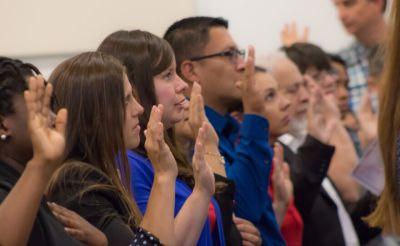
For the majority of us, immigrants, who had known hardships, including threats of death in our old countries, the swearing-in ceremony will remain etched into our hearts and minds as long as we live. The sense of belonging will permeate our beings and enrich us with a spirit of can-do in good times and bad.
Find a picture of any group being sworn in as citizens and you will see a host of emotions reflected on their faces, pride, joy, resolve to get ahead in life, and the savoring of a significant and solemn moment in their lives. And so, it was done. I felt complete.
Reprinted with permission of “Our Neighborhoods,” Winter 2025-26 edition.