
As told to Celeste Helm
I was born into a military family. When I entered the scene, we already had four generations that served going back to the Union Army in the Civil War. Three generations graduated from West Point, including my father, Major General, Joseph L. Dickman. My older brother went on to serve as a B-52 pilot in Vietnam.
That’s a lot of pressure for a kid hitting his teens in the 1960s. Due to my dad’s career, I attended 13 schools before I graduated from high school. I was always behind, either going over material I had studied in the last school or jumping ahead to topics with no previous foundation.
I never had a chance to make friends. Throughout my childhood, I felt, in [Bob] Dylan’s words, like a “complete unknown, like a rolling stone.”
My salvation during these years was the developing music scene. Mainstream folk music became a talisman that anchored my psyche. It provided a message that seemed to give some purpose, something to inspire and hang onto. I listened to Dylan, The Kingston Trio, Joan Baez and up and coming sounds from The Byrds, Buffalo Springfield, Jefferson Airplane, and The Lovin’ Spoonful. And then there was the rise of pure rock and roll, exciting and new – the birth of something unique in the history of music. Still in high school, I picked up an acoustic guitar and began to play.
 I became good enough to strum with a couple of fellow students forming a folk group, and later I joined a rock and roll band called The Villagers. We became a popular local band around Colorado Springs, where I graduated from high school in 1967.
The Vietnam war was raging, and America’s young people largely fell into two camps. One was made up of young men drafted or volunteering to serve in Vietnam. The other gave rise to the hippie movement, the “flower children” advocating peace and love. I fell squarely into the latter group and could not wait to escape the suffocation of a military base.
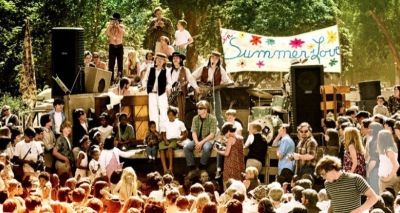
Although my dad couldn’t relate, he was aware that I was unsuited to carry on the family tradition. After I registered for the draft, I slung my guitar and a sleeping bag over my shoulder, and along with my high school friend, Mac King, we walked out to Colorado’s route N25 and stuck out our thumbs. It was the summer of 1967, and our destination was Haight-Ashbury in San Francisco. We didn’t know it then, but we were about to become part of a movement known as the Summer of Love.
It’s 1,300 miles from Colorado Springs to San Francisco. Mac and I left with little money and less sense. We traveled through Colorado, Utah, and Nevada, safely arriving in California after several days of relying solely on strangers.
We had no plan, nowhere to stay, and not enough funds to support ourselves. But we had a feel for adventure, the hippie vibe of the day to “drop out” of mainstream society, and our passion for music.
Hitchhiking was still an acceptable and reasonably safe mode of transportation in the 60’s. Our jeans, long hair in ponytails and our guitars were our calling cards as bona fide hippies. There was a sense of brotherhood and safety when hippies recognized like-minded others or those that were simply empathetic to this new movement. Ride after ride, we traveled through magnificent country and met kind people along the way.
It was illegal to hitchhike on the side of a highway. As long-haired teenagers, Mac and I had no interest in crossing paths with the law. We had to position ourselves before an on ramp to wait for a ride.
Truckers never offered a ride and Lincolns and Caddies were not the vehicles stopping for us. Lifts were provided by folks driving 10-year-old Chevy’s and battered station wagons.
Most hops were short, and we would get lifts for a couple of miles to 15 or 20 miles at a time. Mac and I had only one dangerous moment along the way. As we stood on the side of the road near Salt Lake City, we saw a pickup truck coming too fast down the highway. As it flew by, a couple of teens threw a bottle, just missing us. In response, we yelled obscenities at them. This turned out to be unwise. They turned their truck around and came after us. Mac and I took to the fields kicking up dust with our guitars in hand. The boys ran after us for a short time. It was our good luck that they weren’t seriously interested in doing harm and gave up quickly. Not a life and death situation, but at that moment, it put a scare into us.
When we arrived in Haight-Ashbury, we had the ultimate experience of living one day at a time. On rough nights we slept on park benches and in alleyways. The fading facades of the turn-of-the-century brownstones provided covered porches for refuge, and Mac and I often met other folks staying at various houses. We were always moving around, one place after another. For a short period of time, we stayed at Janis Joplin’s house. She opened her home to people like us when she was away on tour.
And the magic of the music was everywhere, local parks, clubs, street corners, homes. It was powerful and soothing at the same time. Everyone was your brother or sister, and everyone knew someone that could help you or just enjoy the shared experience while passing through. We spent a lot of time in both the Golden Gate and Panhandle parks and were happy to hear artists such as the Grateful Dead, Jefferson Airplane, Janis Joplin, and Country Joe and the Fish.
Ever short of funds, Mac and I took odd jobs, including traveling to northern California to pick fruit so we could buy food. On at least one occasion I donated blood. I think by the end of our time there, I had sold my guitar.
Summer was fading and my funds and stamina were fizzling out. My dad wasn’t warm and fuzzy, but he never closed the door on me. He arranged for an airline ticket, and I flew back to Colorado. After a few months, to keep me out of harm’s way – mostly from myself – he shipped me off to Thule Air Base in Greenland. I spent a year working at the military installation 750 miles north of the Arctic Circle. Talk about a 180 in terms of life experience!
In 1969, I joined over 400,000 fans at Woodstock, where 32 bands performed outdoors with the theme of peace and music. This was the pinnacle of the counterculture movement. In the 70’s, both the flower children and the Vietnam war were left behind. Sadly, the outcome for many on both sides was heavy drug use, alcohol abuse, and chronic homelessness. It was a prevailing disillusionment that had heavy consequences. A few years after I left Mac in San Francisco, I learned he succumbed to drug use and took his own life.
It was slow progress, but I wanted a better future – a productive life. With the unfailing support of my mom and dad, I navigated the rough patches and came out ahead. I survived and thrived. I kept traveling on and didn’t think twice, it was alright.