
By Bob Woods
 Around 2005 I started my family research on Ancestry.com. The show “Roots” popularized the process and has given us some insight into what you may find in your search. In my case, I knew very little about my family beyond the great grandparent level.
The other source of data comes from the DNA testing and matching process. Ancestry’s DNA process not only locates other Ancestry members who share your DNA, but it pinpoints what part of the world you’re likely to come from. Connections through Ancestry will predict whether a person is likely to be in your family and also what relationship they represent such as cousin, aunt, uncle, great grandparent, etc.
So, what did I learn after years of research about the Woods’ family? First of all, the Woodses originally went by Wood and the name was changed to Woods in the late 1800s. Another bit of information revealed they were Quakers from England that passed through Philadelphia in the 1700s and migrated down the Wilderness Trail to North Carolina. The earliest of the group was Joseph Wood. The information comes mostly from Meeting House records.
On the other side of the Woods family, the Royall’s came to Jamestown, Virginia in 1622 right after the Jamestown Massacre. The first immigrant was Joseph Royall. He settled upriver in Charles City County and patented 1,200 acres on the James River. He lost his first two wives to “the [Yellow] fever” and eventually brought over a third wife from England.
He was trained as a sea captain and was the first mate on a ship named, “Charitie.” As he patented 1,200 acres and you received 50 acres for each immigrant, it appears he sponsored 24 people, including his three wives.
On my maternal side the original immigrants came in 1731 from the Rhine Valley in Germany. Their German name was Hertzog and they anglicized to Hartsock. They settled in New Jersey after landing in New York.
 Within a generation they had moved west into western Maryland. After a failed attempt to move further west into Pennsylvania and Indian Territory, they headed down the Wilderness Trail to southwest Virginia and beyond. They were farmers.
In the bigger picture, how many drunks and horse thieves did I find? First, I found zero horse thieves. Apparently, it takes a lot of effort to steal a horse. Drunks are in question but nothing more than normal for the times at hand. I did find one axe murderer, but he was an in-law who killed his wife in 1889 and was hanged six years later in Carroll County, Virginia. He was among the last persons hanged in Virginia before the electric chair was adopted for capital punishment.
Progress to date includes a database that has over 11,000 people and a lot has been learned about our family. It includes one U.S. president –Thomas Jefferson, two governors – William Randolph of Virginia and Issac Shelby of Kentucky, and a lot of other people who lived ordinary lives. Many were farmers or adventurers who wanted to try something different.
There is a messaging feature on Ancestry.com that allows you to contact people with a DNA match. A few years back I got a message from a person who was estimated to be a second or third cousin. After some messaging back and forth, I learned she lived in Roanoke, Virginia and was a retired commercial real estate agent.
When the smoke cleared, I found out she is the great grandchild of none other than the axe murderer mentioned earlier. Her husband is a prominent lawyer in Roanoke, and she had been doing research for some time as well. We made contact and spent time together with her twin sister. She was not what I expected from an axe murderer’s granddaughter.
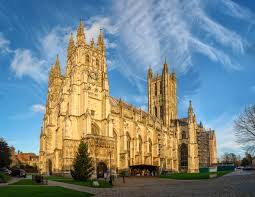
Canterbury Catherdral
One of my most rewarding efforts involved a trip to Canterbury to research Joseph Royall’s background. I went to Canterbury Cathedral, and I was issued a picture ID to allow me to enter each day without paying an entrance fee. I learned that the name Royall with two l’s was the French spelling of the name and implied that the family probably worked for royalty but were not royalty themselves. The Royall’s were an old Norman family who likely participated in the Norman Invasion.
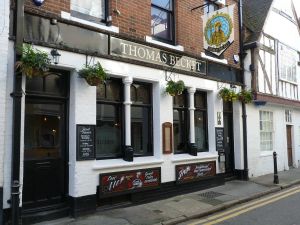
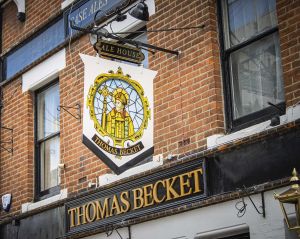
A couple of days before the end of our trip we decided to get a late lunch at a local pub – The Thomas Becket Pub. I went to the bar to order, and I decided on the best lunch from the menu. An elderly gentleman at the bar assured me that the steak and ale pie was the best. He inquired as to why we were visiting. He was celebrating his 87th birthday with a pint and had time to talk.
I told him that 397 years ago my 7th great-grandfather sailed from Canterbury to Virginia. “Three hundred and ninety-seven years ago?” he asked. “Yes,” I answered. “We wondered where you had gone,” he replied with a smirk.
I bought him another pint.
To summarize the lessons learned so far in my research:
- First, don’t assume the worst or the best. Let the data guide you and be skeptical of it.
- Multiple sources almost always improve the quality of the data itself.
- Don’t take what you find too seriously and keep your curiosity.
- Learn to take the good news and the bad.
- Everyone has an axe murderer or the equivalent somewhere.
Reprinted with permission of “Our Neighborhoods” Summer 2025 edition.