
 By Mary Kay Rotert
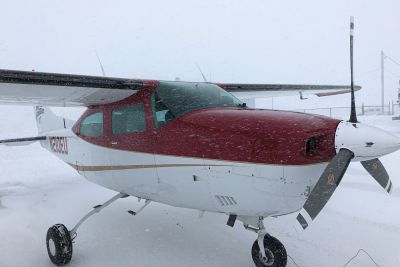
Just before the Millenium (AND before the common usage of GPS and cellular telephones), my late husband, Charles Rotert, “decided” that we should take a long trip in our single-engine Cessna 182. I was used to his “adventurous hi-jinks,” so I absent-mindedly agreed.
“Are you nuts?” I screeched later, when he presented me with the upcoming itinerary. The booking came from a travel outfitter called “Northern Adventures,” a husband-and-wife team of experienced pilots, who organized small-plane excursions from Montana up to the Arctic Circle and back. Participants came from all over the United States, but we were the only travelers from the East Coast of the U.S.
You might ask, “How were we two qualified, and approved, for such an experience ?” Charles was an experienced twin-engine pilot of many years; he had a sea-plane rating, as well, and had been a Flight Instructor for many years. So, he was the “Pilot-in-Command” (PIC ).
I had taken flying lessons, including aerial navigation, and had learned how to do emergency landings. I was not eligible for a pilot’s license, and not allowed to fly solo, due to a problem with vertigo. Therefore, I flew “right seat,” and handled the radios and the navigation charts. I also relieved the PIC for short bursts of rest, when flying conditions permitted it.
Therefore, in early June of 1999, Charles and I flew, alone, for three days, crossing most of the United States, from Virginia to Helena, Montana, near the Canadian border, in absolutely beautiful flying conditions.
One of my most favorite memories is flying over Montana and following the Bozeman River, which is fairly straight in its course to the West. Charles needed some rest, so he handed the controls over to me and said, “Just follow the river; hold the altitude and keep the wings straight and level.”
I sat there for two hours in utter bliss, just reveling in the beauty and serenity of it all, while our little Cessna N59839 carried us safely into Helena, Montana. There, we joined our two guides and the flight crews of seven other airplanes. Together, we became a “Flight-of-Eight,” with only the guides’ aircraft being allowed to talk to Flight Controllers, etc.
The slowest plane in the fleet took off first, followed by the second-slowest, etc. the fastest plane brought up the rear. That way, we (hopefully) all landed at our destination about the same time!
We all flew almost every day – in daylight hours only. On occasion, we stayed over for 2-3 days in places of interest: the “Calgary Stampede,” for instance.
The routine NEVER changed. There was always a breakfast meeting, in which we were given that day’s schedule, flight conditions, instructions, and navigational charts – from which none of us were EVER allowed to deviate.
The first day’s destination was to Calgary, in the southern province of Alberta, staying over for their famous “Stampede,” a fabulous rodeo. Canada is second to Russia in total land area, but 90% of its population resides in a 100-mile swath of land on the US boundary. It is the only area with enough agricultural and industrial activities to support a human population. The rest is mostly frozen tundra and mountains/lakes/rivers.
I don’t have the Flight Logbook any longer, so I don’t remember the itinerary completely. But we spent the next few days flying, always together in a sort-of-formation, over the northeastern corner of British Columbia, with the entire line of the Canadian Rockies as a backdrop on our western side, finally crossing them somewhere in the Yukon.
We stayed at or under an altitude of 10,000 feet, so that we did not have to worry about a loss of cabin pressure – or icing on the wings!
The days were long, with a lot of territory to cover, but the territory beneath us was breathtakingly beautiful…. We would usually land in late afternoon in small or mid-sized towns, with small airports and hotels/restaurants nearby. Before crossing into the Yukon, we had been mandated by the Royal Canadian Mounted Police to prepare our aircrafts with at least two weeks’ worth of emergency provisions and water – AND a shotgun! Charles and I had removed our back seat to accommodate the extra gear.
Two fellow pilots, flying together, had loaded up their cargo space with huge amounts of trail mix and M&M’s – their idea of “emergency provisions!” The RCMP (Royal Canadian Mounted Police) warned us that, if we went down anywhere in the Yukon, they would make an attempt to find us, but it might take as long as two weeks!
Having made it safely that far, we headed back into American territory when we crossed into Alaska. Alaska famously has only two seasons: Winter and the Fourth of July! BUT their July is gorgeous, with wildflowers blooming everywhere.
In Fairbanks, we booked some seaplanes to fly us down to Kodiak Island, the home of the Grizzly Bear! Before venturing on foot down to the waterfalls, where the salmon run up-stream, we HAD to go to “Bear School,” a two-hour audio-visual telling us what to do and what NOT to do if we had a bear encounter. We were advised to make as much noise as possible along the path and were given jingle bells to wear on our wrists. Halfway down our trail, a HUGE male reared from the brush where we had awakened him. But he was sated with salmon & quickly went back to sleep.
In the Klondike, we visited the training facility for the Alaskan huskies which are used in the famous Iditarod Race. They are absolutely gorgeous animals, especially the young pups, who want to do nothing but run – anywhere, everywhere! In Skagway, we took an old train for a trek up one of the mountain peaks for more spectacular scenery. Skagway looks just like the filming site for one of our good ol’ American western movies.
Before leaving the Fairbanks area, we took a flight around Mount Denali (now called Mount McKinley) in absolutely gorgeous weather! We had been told that it is obscured by clouds on most days. We were also allowed to stay in the old Denali Hotel, which is now closed to the public; all visitors have to leave the park before dark every day.
Anchorage is (or was) accessible only by boat or plane; there were no roads in 1999. We also flew for a while over the famous Alcan highway, and the Alaska Pipeline. Our final air trek was to Barrow, the last point of land before the North Pole. True to its name, it is very “barren.” Just a few Inuit cottages, and miles of frozen tundra. No Polar Bear sightings.
The trip had taken 10 days, but now we faced 10 more days of re-tracing our course, back to the United States. We left our new friends, some of whom became lifelong flying pals, in Helena, Montana, where we also devoured a fair amount of trail mix and M&M’s!
After some days of rest, Charles and I still faced three days of airtime, flying over South Dakota, Minnesota, and Ohio. In South Dakota, we made an attempt to find the four Presidents’ Memorial, carved into the side of one of the mountains, I am embarrassed to admit that, even with a navigational chart, showing its location, we NEVER found it – despite flying around that damn mountain several times! We did find the adjacent monument to the Indian chief Sitting Bull, which was in the process of being carved at that time.
Coming in on our final approach for a landing in Pierre, South Dakota, the Eustachian tube in my left ear suddenly popped open – it had been blocked for 5-6 weeks due to a bad head cold. I shrieked at the odd sensation into my head mic, which did NOT endear me to either the PIC (Pilot in Command) nor the Air Traffic Controller who was guiding us in.
That was the last memorable event of what had been an absolutely stunning and enjoyable trip. None of the eight aircraft had suffered any serious mechanical difficulties, and none of the flight crews had suffered anything other than minor illnesses.
At Hummel Field, as the PIC descended from N95983, he patted her and said “What a great adventure! Let’s do something like it again!”
Well, maybe…
Reprinted with permission from Our Neighborhoods.