 By Renate Muller
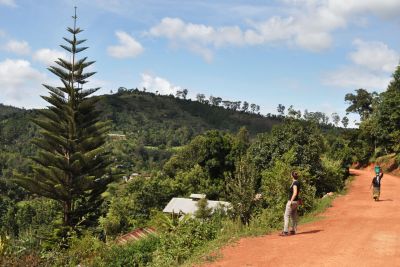
I was born and spent the first 12 years of my life on a farm high in the Usambara mountains of Tanzania, East Africa. My parents were immigrants from Europe. My father was a Swiss-trained engineer and architect. He met my mother as she was disembarking off a steamer from Genoa, Switzerland.
She traveled alone and was ready for an adventure.
Together they bought a large piece of land in the mountains and our farm, “Mkuzzi,” was born.
The climate, at 5,000 feet, is like the Mediterranean with two rainy seasons but no cold or hot weather. My mother grew all the plants on the farm from seeds or cuttings. Our house was built from bricks produced on the land. Electricity came from a water-powered turbine with a battery bank. The water for that was diverted from the river in our valley. Wood was plentiful in the jungle behind our house.
Everything we needed and ate came from the farm. We had many animals – cows, chickens, ducks, sheep, geese, and pigs. Two German Shepherd dogs kept the monkeys out of our orchard and coffee plantation. Peacocks were the only useless animals on the farm.
All the helpers we needed on the farm and in the house came from the surrounding villages. They all spoke Swahili and were illiterate, kind, and trustworthy people.
My sister and I grew up speaking German with Mother but English in the boarding school we went to in Aruasha. We also learned Swahili.
Mother ran the farm, and we were free to wander everywhere – climbing trees, swimming in the river, or helping with the animals. We were always under the watchful eyes of the native workers who kept us safe!
After World War II in 1946, our parents decided we needed a better education than was offered locally. The only way to go to Europe was by traveling down the Nile to Egypt. There were no ships or planes available. That meant a long train ride to Uganda and South Sudan to Juba. We travelled under the guardianship of a Swiss family with similar aged kids; our parents could not make the trip.
The ship we boarded in Juba was a triple-decker paddle wheeler. It stopped at countless villages along the way where people and their animals would disembark or join us. It was a noisy but joyful crowd, and we often joined them tasting their food and helping with their animals and children.
In Khartoum we waited for two weeks for a further connection to Cairo. From Cairo, we managed to catch a military plane to Naples, Italy, and from there by train to Switzerland. All in all, a 6-week journey. From there on to a boarding school in Hastings, England.
The 1947 winter was one of the coldest and the food rationing was crippling. We saw our parents every two years for a few weeks!
My sister stayed and settled in England. At 17-years-old, I managed to persuade my father to let me return to Africa for 6 months. I also managed to persuade him that I needed to climb Mount Kilimanjaro as a birthday present!
Back in Switzerland and another boarding school this time with bilingual (French and German) students and teachers. I needed that final exam to go to medical school in Basel, Switzerland.
At that university, my future husband was studying chemistry. We both finished with degrees in 1960, and almost immediately left for the U.S. to continue in our chosen fields as post-doctoral researchers at Harvard and MIT.
Three years later we packed up and drove across country to Los Angeles in our VW Beetle to continue our studies at UCLA.
Back in Switzerland, our two children were born, Hans joined a pharmaceutical company, and I gave up full-time medicine to look after two small children.
Briefly the rest of the story….back to the U.S. – New Jersey, then Puerto Rico for four years and on to Australia for three. Back stateside Hans retired. We moved to the Northern Neck for 20 years, sold our house to move to New Mexico for five years just to get a taste of the high desert and southwest. We just missed the Northern Neck too much and returned.
This is truly a lovely final resting place; we are grateful to be here.
Reprinted with permission from the Summer 2025 edition Our Neighborhood.